Wednesday, May 22, 2013

Sanguinaria canadensis

One of the loveliest surprises in the garden this spring has been the appearance of Sanguinaria canadensis, or bloodroot. A native plant to the eastern United States, including Minnesota, bloodroot appears in early spring and has beautiful white flowers.  The cultivar in the display and trial garden is a double flowering form, making it especially showy in the landscape. 
 The root in bloodroot has a red juice, hence the name.  This juice was traditionally used as a dye and an insect repellant.  Although sometimes touted as a medicinal plant, bloodroot is actually quite toxic.  Currently, research is being conducted on the use of bloodroot in cancer treatment.  It is known to be an antiseptic and anti-inflammatory. 
Bloodroot grows best in a rich, moist but well-drained humusy soil.  It prefers shaded areas, as you can see in the display garden.  Bloodroot looks wonderful in a woodland or shade garden.  It's beautiful white flowers will add a spark to the garden in early spring.

Saturday, May 11, 2013

Mulch: Why it's awesome and how to use it

File:Mulch shredded yard waste.JPG
Image compliments of Wikimedia commons,
 http://commons.wikimedia.org/wiki/File:Mulch_shredded_yard_waste.JPG


This week was mulching time!  We are pretty lucky on the St. Paul campus to have compost from the animal barns on campus to provide us with mulch for the display and trial garden.  Mulch has so many benefits for your garden, it's hard to list them all but I will give it a try.
  • Helps retain soil moisture
  • Helps stabilize soil temperature
  • Provides habitat for beneficial insects
  • Asthetics
  • Improves soil structure
  • Suppresses weeds
  • Protects plant roots from extreme heat AND cold
  • Adds soil nutrition
  • Prevents soil erosion
  • Prevents soil campaction
I could keep going, but I think you get the point. Mulch is an important part of the garden. So how can you incorporate it into your garden?  There are lots of different types of mulch so I will just highlight a few organic (bark, leaves, compost, etc.) types of mulch. 
First things first. Every good garden has a compost pile.  Put dead leaves, grass clippings, weeds (as long as they haven't gone to seed yet), and kitchen scraps in your compost pile.  This waste, once composted can make excellent mulch. 
In addition to compost, bark, chopped leaves, straw (not hay!), and wood chips make good mulch.  Simply spread this out around your plants, leaving enough room for them to poke out.  2-4 inches is usually sufficient. 
If you are interested in getting a bit fancier with your mulching, or if your soil is in serious need of help, you can try "lasagna mulching".  Here's a recipe for lasagna mulch from "The Urban Homestead" by Kelly Coyne and Erik Knutzen (great book, fun read):
  1. Stomp or mow down weeds.  No need to pull them up.
  2. Water the soil if it is dried up.
  3. Spread a layer of manure--rabbit, chicken, or horse is best.
  4. Lay down sheet mulch as a weed barrier.  Cardboard, newspaper (but not the shiny inserts), cotton sheets all work well.
  5. Put down a layer of compost, three or more inches.
  6. Add the top dressing. This is the part that should look nice.  Dried leaves, straw, bark, wood ships, or pine needles will work well.  
  7. If your soil is really poor, let this rest a full year before planting.  After one year, there should be significant improvements.

Friday, May 3, 2013

Snow and Daffodils

Sometimes in Minnesota, winter doesn't want to end. We hoped to get some gardening done today, but were thwarted (at least a little) by the unexpected May snow.  While of course we are all ready for spring's warmth, I have to admit it is kind of beautiful to see snow on the blooming daffodils.


Silly Winter Facts:
  • The largest snowflake ever recorded was 15" wide and 8" thick.

  • In 1997, 47" of snow fell in one storm in Lake County, MN.

  • The record low in Minnesota is -60F, while the record high is +114F.

Forecast for next week:

The sun will come out on Sunday and the forecast calls for 60 and 70 degree temperatures all week.  We can't wait.


Tuesday, August 14, 2012

How is it already Mid-August??

The past few weeks, the temperature has gone down which helps with our weed control in the garden.  We're making sure the garden is up to standard for the fall horticulture identification course. The class tours the garden while learning about and identifying perennials. The other big project we've undertaken is rebuilding the deck.  The old one rotted through in some places and had nails sticking up all over.  It was time for a new one!
This month we went to University of Minnesota-Morris for their horticulture night.  In comparison, they have more annuals than perennials.  We have more trees and height features.  Our group took some pictures. enjoy!

 before we left...twins!
At Morris' children garden section

New Bloomers!
 Globe Flower
 Joe-Pye Weed
 Russian Sage with low Sedum
 Pink Turtlehead
 
 Coreopsis
 Goldenrod
 Blanket Flower..blooms all summer!

Tuesday, July 24, 2012

Attack of the Japanese Beetles

All month we've been dealing with the Japanese Beetles in the garden.  They've been specifically after our grape vines, roses, and herbs.  Our first approach is to spray Kaoline Clay.  This is not a chemical, but clay that coats the outer layer of the leaves.  It does not affect the plant at all, instead deferring the beetles from eating the leaf. Another way to get rid of them in a smaller garden requires only a bucket of soapy water.  If you go around and knock them into this bucket, they will not be able to survive.  Note that if it's only water without soap they will survive when you dump them out.
On the picture above, you can see a beetle in the left corner of the main leaf shown.

New Bloomers!
 Cardinal Flower (needs wet area to thrive)
 Phlox
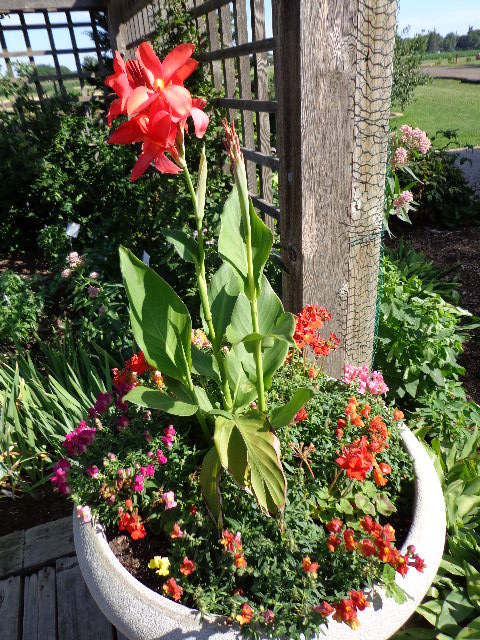
 Canna lily surrounded by Snapdragons and Geraniums
 California Poppies
 Mums, blooming earlier than usual
 Me playing with my new panoramic setting on my camera!

Saturday, July 7, 2012

Heatwaves of July

So far this month, our goal has been keeping ourselves cool and plants alive during these hot temperatures.  The edible garden seems to have finally established itself.  We put up fencing to keep rabbits from eating our vegetables to the ground as soon as we plant them.
New Bloomers!
Beebalm
 Coneflower
 Hydrangea
 Daylily
 Sunflower
 Monkshood


Ligularia (only yellow flower that grows in shade)

Tuesday, June 19, 2012

Current Projects:
We've been focusing on weeding.  All the rain has caused them to surface like crazy. Aside from that, we went to the roof of Alderman and took a picture overlooking the garden!


Another project that's in its beginning phases is a redesign of the area surrounding Alderman Hall. Morgan and I are very excited to work on this vision.  We will be looking at the front entrance of the building as well as a path that leads around the side of the building down to the garden.  The pictures below represent what the areas look like now.  Soon I will be posting our drawings and renderings of our ideas!


New Bloomers:
This week all of the daylilies have been blooming.  The butterfly bush and lilies have also begun and will produce many gorgeous flowers. More pictures to come of those! Finally, the Evening Primrose has a few large yellow flowers blooming. 
 Daylily
 Asiatic Lily
 Evening Primrose (Oenothera)
   Butterfly Bush