Wednesday, July 3, 2013

Welcome to July!

It's been a hot, dry week in the garden.  After a couple months with constant rain, it was nice to have a few dry days. That said, let's hope it rains this weekend (after everyone has gotten their 4th of July celebrations in, of course).  As we wait for rain, a post on drought tolerant plants seems appropriate.

Using drought tolerant plants in the landscape is really a smart choice for everyone. For starters, you won't have to spend time watering as often. In addition, water conservation is becoming a more important issue as clean water becomes more and more scarce and our population is on the increase.  Choosing appropriate plants is the best way to conserve water in the landscape.  Many Minnesota native species are drought tolerant, so inadvertently you will also be helping spread native plants!

Many juniper and pine species are drought tolerant and can be good landscape trees and shrubs. Bur oaks are a good choice if a larger tree is needed.  There are a ton of good perennial options out there, so I will just list some of my favorites:

Yarrow
Echinacea
Rudbeckia
Irises
Peonies
Salvia
Sedum
Little Bluestem
Baptisia
Check out this list from the UMN extension for more options:
http://www.arboretum.umn.edu/droughttolerantplants.aspx

During last summer's drought, I saw a ton of dead lawns. If you are thinking of redoing your turf grass, consider using a Fescue mix instead of Kentucky Bluegrass for a more drought tolerant lawn. Some seed companies are even selling slow growing species, cutting down on how frequently mowing is necessary. 

Hopefully this dry spell doesn't last. Our vegetable garden has been loving the rain.

On a lighter note, check out what is in bloom right now in the garden!


A large variety of roses, some developed at the University of Minnesota

Poppies

Stonecrop Sedum

More sedum- Dragon's Blood variety

Veronica, or Spike Speedwell

Globeflower

Lavender

Yarrow

Serviceberries are ripe and delicious!


Saturday, June 22, 2013

Storms and the garden

Some sad news today: the arbor on the west end of the garden blew over in yesterdays insanely windy storm. Thankfully, we didn't lose any trees in the garden, although many were blown over on campus.  In honor of our lost arbor, today's post will be about preparing your garden for a nasty storm. I will also talk a about trees, as many beautiful old trees were lost in the storm.

Most advice on storm preparation is geared towards preventing damage from hurricanes. Lots of this information is still applicable for us in the Midwest, as high winds in a storm and flooding can cause major damage to the landscape. Trees are generally most impacted by these winds.
Maintaining a healthy tree is the best thing you can do to prevent damage.  Removing dead, dying, or weak limbs is the best way to prevent a tree from uprooting or dropping branches.  When pruning, keep branches that have a 45-90 degree angle to the trunk. Staking taller plants or plants with weaker stems can prevent them from snapping.  I'm proud to say none of my tomatoes toppled over yesterday. Bring hanging baskets into the garage. 

After a storm has passed through, be sure to inspect trees for damage.  Broken limbs should be removed back to the trunk of the tree to minimize disease susceptibility.  If bark has been torn away, clean the edges of the wound to speed the healing process.  The Arbor Day Foundation has a great article on repairing storm damaged trees.
Check it out: http://www.arborday.org/media/stormrecovery/4_treefirstaid.cfm

Sometimes, obviously, trees need to be removed and replaced.  While it is sad to see an old tree go, take the opportunity to pick something fun and new for your landscape. Here are some interesting and unique options:
File:Ginkgo biloba MN 2007.JPG
http://commons.wikimedia.org/wiki/File:Ginkgo_biloba_MN_2007.JPG
Ginkgo biloba can grow up to 50' tall.  Leaves have a great fall color and the tree maintains a nice rounded form. I also really like the bark texture. The UMN extension recommends purchasing a 4-5' tree to insure Winter hardiness.
File:Pink flowers.jpg
http://commons.wikimedia.org/wiki/File:Pink_flowers.jpg
Flowering Crabapple trees are a great way to add some color to the landscape. And you can make pickled apples out of the fruit! Size can range from 7-25' depending on the cultivar. There are many different types available.

File:Ostrya virginiana 2.jpg
http://commons.wikimedia.org/wiki/File:Ostrya_virginiana_2.jpg
 Ironwood, or Hop Hornbeam, is a nice native tree for the landscape. The bark is very smooth and they grow some interested catkins, resembling hops.  Ironwood can grow 25-40' tall.  The tree has few insect or disease problems and will tolerate a wide range of soils. 
File:Elaeagnus angustifolia (habitus).jpg
http://commons.wikimedia.org/wiki/File:Elaeagnus_angustifolia_%28habitus%29.jpg
 Russian Olive Trees are grown for their silvery foliage.  The trees, considered shrubs by some, grow up to 25' tall. They are drought and soil tolerant, making them pretty easy to grow and maintain.

 For a more complete list of trees for the Minnesota landscape, refer to the UMN extension website: www.extension.umn.edu/distribution/horticulture/components/0545frame01.html

Wednesday, June 12, 2013

Greening the Garden


Gardening isn't all about plants.  As environmental awareness increases, more and more people are finding ways to "green" up the garden.  There are lots of ways to make the garden more environmentally friendly, ranging from complex projects to simple things that can actually save you money.
  
File:Kilmeadan - The Cosy Thatch Pub rain barrel - geograph.org.uk - 1635414.jpgRain barrels are a great way to reduce water usage. Rain barrels sit under the downspout of roof gutters to collect rainwater from the roof.  We don't have a rain barrel in the garden since we don't have any shelters with gutters, but they are definitely a great option for the home garden.  Most home improvement and garden stores carry rain barrels, with prices ranging from $60 to $150.

Making your own rain barrel is also an option if you can get your hands on a barrel.  It's usually easy to find 30 gallon plastic barrels on craigslist. Make sure that they were not used to store any harsh chemicals.  Barrels used in food manufacturing work well.  Hardware stores sell spigots to add to the barrel. Putting a screen on top is a good idea, as this will keep debris from clogging up the barrel.

Whether you buy or make your rain barrel, water pressure needs to be high for a hose to be attached and functional.  This can be achieved two ways: a pump or elevation.  A raised platform will provide enough water pressure to be able to use a hose. Otherwise, an electric pump ($60+) will create needed pressure, enough to power a sprinkler or a soaker hose.

File:Compost Bins - Vale Grove.JPGComposting will help you add organic matter back to your soil and also keep garden waste out of landfills.  Composters can be purchased or built pretty easily.  Prices on composters range from $60-$200 depending on the style on size. Most manufactured composters are barrels with a crank that allow gardeners to turn the compost easily.  Turning compost speeds the breakdown process and produces better compost. 

Homemade bins can be complex or simple.  The easiest way to build your own compost bin is with pallets. Pallets can be found easily for free.  Simply take three pallets, arrange them in a square with one side missing, and nail them together.  Leaving the front open will make it easy to turn the compost with a pitchfork.  More complex compost bins can be made with three separate compartments, allowing for multiple loads of compost to be processing at once at different stages. 

Knowing some best practices for composting is important. Compost piles need air, water, and nutrients for optimum performance.  When rain water is not keeping your pile sufficiently moist, watering the pile is important to encourage microbial activity and speed breakdown.  Different materials have different carbon:nitrogen ratios.  To provide the best ratio (30C:1N) pay attention to the things you are adding. Green stuff (grass clippings, manure) is high in nitrogen, while browns (sawdust, dried leaves) are higher in carbon. If the ration of C:N is too high, nitrogen fertilizer can be added to fix the ratio. Turn the pile 1-2 per month to speed decomposition.  For more details on composting, check out the University's Extension website: http://www.extension.umn.edu/distribution/horticulture/DG3296.html

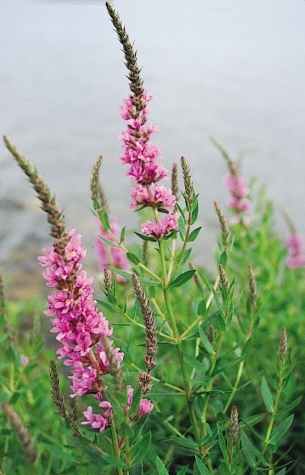
File:Purple loosestrife.jpgWise plant selection is another way to minimize your environmental impact in the garden.  Native plants are usually better adapted to the climate you live in and will likely require less inputs than non-native plants.  Knowing the micro-environment of the location you will be planting in can help in plant selection. Finding out the soil type, drainage and water availability, and light in the area of the garden and selecting plants that are well adapted to those conditions will mean a healthier plant, less work for you, and a lessened environmental impact. 

Always avoid planting invasive species in the garden, as these can have major impacts on ecosystems.  Many invasive species are introduced by horticulture practices.  The Minnesota Department of Natural Resources has a thorough list of invasive plants, along with recommend removal methods.
https://www.dnr.state.mn.us/invasives/terrestrialplants/index.html

The plant pictured above is purple loosestrife, a plant that has invaded Minnesota's lake shores, riverbanks, and marshes.  It is thought to be spread from gardens and nurseries in the state. 

Gardening is a wonderful way to connect to nature and the outdoors.  Incorporating sustainable practices into horticulture is vital for our environment, our health, and the future of gardening.  Throughout the summer, we will keep posting more ideas on greening up the garden. Enjoy!

Images from wikimedia commons:
http://commons.wikimedia.org/wiki/File:Purple_loosestrife.jpg
http://commons.wikimedia.org/wiki/File:Compost_Bins_-_Vale_Grove.JPG
http://commons.wikimedia.org/wiki/File:Kilmeadan_-_The_Cosy_Thatch_Pub_rain_barrel_-_geograph.org.uk_-_1635414.jpg


Thursday, June 6, 2013

Pruning in Minnesota

File:" Green Pig" - geograph.org.uk - 245244.jpg 

You don't need to create animals out of your shrubs to use good pruning techniques.

Image from http://commons.wikimedia.org/wiki/File:%22_Green_Pig%22_-_geograph.org.uk_-_245244.jpg
 

Why prune?
Pruning is an art form for many.  Bonsai, espalier, and topiary all use pruning techniques to create beautiful works of art.  Bonsais known to be over 500 years old are still alive and on display today.  Trees ranging from apple to ginkgo are made into living fences through espalier technique.  Luckily, the average homeowner really just needs a few basic techniques to provide appropriate maintenance for their trees and shrubs.

Pruning helps maintain a healthy plant by removing dead wood from the tree or shrub. It can also prevent a plant from injuring itself from rubbing.  Pruning can also improve the aesthetics of a plant.  By pruning, gardeners can have a certain degree of control over the size and form of the plant.  Pruning can also encourage new growth and flowering.
  
When to prune
Pruning should be done on new shrubs and trees right away to remove dead wood.  Shaping of the plant can also begin right away.  Any branches growing inwards should be removed.  Branches can be removed to provide space for other branches.  Remember that the plant is going to get a lot bigger, so try to visualize what the branch will grow into.  As the plant grows, remove low growing branches to keep the crown high.

Winter can be the ideal time to prune most trees, as the tree is dormant and disease is also dormant.  Spring flowering shrubs can be pruned right after flowering.  Shrubs grown for their foliage should be pruned before the plant resumes growing in the spring.  As diseases become more of an issue, especially with trees, also be sure to find out the right time to prune first.  Some trees, like Oaks, can be extremely endangered if pruned at the wrong time of year.  Consult a local extension office if in doubt.

What tools to use
Pruning shears are a must have tool for gardeners.  These will work best for trimming smaller, younger branches.  Lopping shears and various saws can be used for larger branches.  Hedge shears can be used when trimming hedges, or for very small young branches. Always keep tools properly sharpened, as a sharp tool will make a cleaner cut, preventing damage to the plant.

Techniques
There are three major types of pruning: Crown thinning, raising, and reduction.

Crown Thinning: This is done to create an open tree canopy or shrub. Basically, you remove branches to imrove form and air circulation.  Any branches that are weak, too closely spaced, are rubbing, or are growing towards the tree should be removed.

Crown Raising: This is done to remove any low growing branches. On trees, this is generally done to lift the canopy higher to create space below. On shrubs, this can be done to alter the form or just to get branches off the ground, which can look poor.

Crown Reduction: This is done to control the height of a tree or shrub.  To reduce the height, the upright leaders are removed. Crown reduction can be damaging to a tree, and is probably best left to the professionals.

When shortening a branch, always cut above the bud that is growing in the direction you would like the branch to grow.  This bud will become the new leader on that branch.

When pruning larger branches, multiple cuts should be made to avoid damage to the tree.  The bulk of the branch should be removed before cutting all the way down to the branch collar, which should always be left intact. 

For more detailed information on pruning techniques and details on when to prune specific species, check out the sources below.

Sources:
University of Minnesota Extension Office
http://www.extension.umn.edu/distribution/horticulture/dg0628.html

Minnesota Department of Natural Resources
http://www.dnr.state.mn.us/fid/october98/10019808.html

Thursday, May 30, 2013

Weeds, weeds, and more weeds


Regular weeding is one of the most important chores in the garden.  Pulling weeds when they are still small is key to good weed control.  Always pull weeds before they go to seed. The first step is identifying that what you are pulling out is actually a weed and not just a perennial that you forgot you planted last year. Following are some common weeds in Minnesota landscapes.

Field Bindweed has a vining growth habit with arrowhead shaped leaves.  It spreads via rhizomes and has very deep roots, making it a difficult weed to control.


Creeping Charlie is a low growing perennial weed.  When blooming, it has small purple flowers.  The leaves are round and scalloped, making it easy to identify. If caught early, creeping charlie is easy to pull. Creeping Charlie is commonly a problem in turf grass.  If in grass, a dethatching rake can aid with removal.


Dandelions can be easily removed by digging up the tap root.  However, several inches of root will need to be removed to prevent it from coming up again.  Always make sure to pull dandelions before they go to seed.


Lambsquarters have triangular or diamond shaped leaves and often have red tinted stems and leaves.  This plant is considered invasive and a threat to native plants.  It can be easily pulled as a young seedling.  Full grown plants can get up to 6 feet tall.


Bishop's Weed is often planted intentionally as a ground cover in the landscape.  However the variegated form, which is somewhat attractive, reverts to a plain form when propagated by seed.  This plant will readily self seed in places where it is not wanted.   It also spreads via rhizomes, so removal can be a bit trickier. All of the plant needs to be removed. It's leaves come in three's with a slightly variegated edge.


Common Burdock produces a large rosette of leaves that are broadly heart shaped and loosely hairy.  Burdock has a long tap root which should be removed to prevent reemergence. 


Saturday, May 25, 2013

Happenings in the garden

It has been a busy week in the display garden.  Mulching, weeding, and planting were top priorities for most of the week.  The edible landscape is almost all planted, with beans, amaranth, beets, carrots, peas, lettuce, swiss chard, Brussels sprouts, sunflowers, corn, and more.

The crabapple trees are in full bloom. Come by and enjoy their fragrance.  


Tulips are blooming throughout the garden, and everyday new perennials are appearing.  


Tulips

Tulips are perennials in the Liliacea family.  They grow best in well drained soil, in full or part sun.  Bulbs are best planted in the fall, about 6-8 inches deep.  Tulips are a great way to add some early spring color to the garden, especially since there are so many varieties. Estimates say there are around 3,000 varieties of tulips.

Did you know...?

Tulips are native to Central Asia (not Holland). 

Tulips are the third most popular cultivated flower in the world.

In the early 1600's, the Dutch went crazy for tulips.  This time is known as "Tulip Mania". A variety then called Semper Augustus is thought to be the most expensive flower ever sold, with estimates in the $100,000+ range.

Here are a few of the varieties we have in the display garden. They are still blooming, so come by and see them for yourself!